Interactive rail training helps learners turn rules, procedures, and operational risks into practical understanding. Because people participate actively, the learning feels relevant and easier to recall.
This approach can support staff who manage infrastructure, route risk, degraded working, and emergency situations. In addition, it gives learners opportunities to practise decisions before applying them during real operations.
Most people have attended training that soon becomes difficult to remember. A presentation covers important information, everyone completes the session, and much of the detail later fades.
That outcome does not mean the training lacked value. However, it shows why explanation alone cannot always prepare people for complex operational work.
Interactive rail training adds participation, discussion, decision-making, and practical activity. Therefore, learners move beyond hearing information and begin exploring how they would use it.
Why Passive Training Can Be Difficult to Remember
Traditional classroom training often relies heavily on presentations, written materials, and verbal explanation. These methods remain useful because learners need clear information before applying it.
However, long periods of listening can make attention harder to maintain. Learners may understand each slide without forming strong connections between the information and their daily responsibilities.
Rail training frequently covers detailed rules, local instructions, technical systems, and operational processes. Consequently, learners must absorb considerable information while understanding how several elements interact.
A trainer might explain a degraded working procedure accurately. Yet learners may still struggle to picture the infrastructure, identify each person’s responsibilities, or follow the developing situation.
Active participation gives that information a practical setting. As a result, learners can connect each instruction with a location, decision, consequence, or required action.
This connection makes the session more meaningful. Instead of remembering an isolated statement, learners can recall how that information influenced the scenario.
What Interactive Rail Training Looks Like
Interactive learning asks people to think, respond, and apply knowledge throughout a training session. Therefore, learners become participants rather than simply remaining an audience.
In rail training, an activity could involve identifying hazards or planning a response. It could also involve positioning trains, signals, points, crossings, stations, or staff roles.
Learners might discuss what should happen next and explain why. Meanwhile, the trainer can introduce new information, challenge assumptions, or change the operating conditions.
For example, a normal movement could develop into a signalling failure. A second change could then introduce poor visibility, communication problems, or an unexpected obstruction.
The exercise requires learners to reassess the situation as it develops. Consequently, they practise adapting their knowledge instead of repeating a rehearsed answer.
Interactive rail training can support individuals, pairs, or wider groups. However, every activity should have a clear learning purpose and a structured conclusion.
How Physical Interaction Clarifies Rail Scenarios
Some railway situations are difficult to understand through words alone. Track layouts, signal positions, junctions, crossings, and train movements all involve spatial relationships.
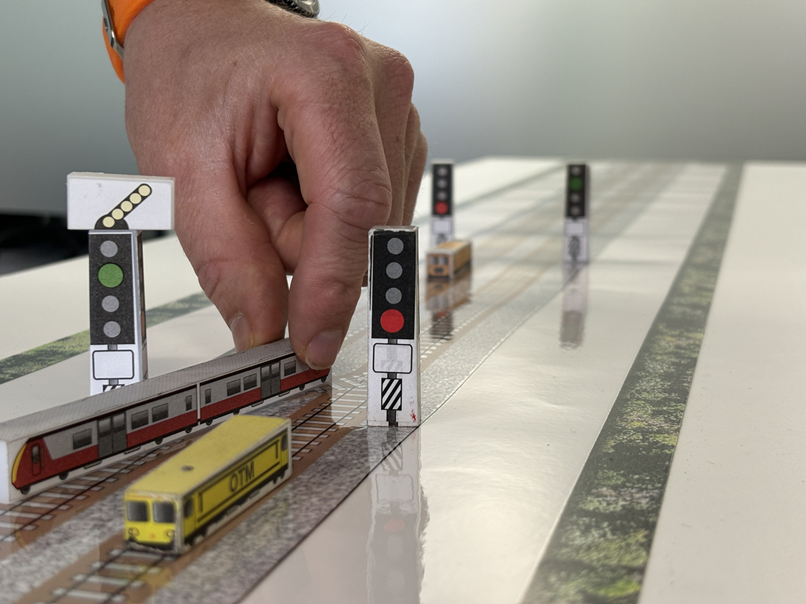
A tabletop simulation makes those relationships visible. Therefore, learners can see where each feature sits and how one movement affects another.
Physical pieces also give everyone a shared point of reference. Instead of imagining different layouts, the group examines the same operational picture.
Learners can move an object, point towards a risk, or trace a proposed route. As a result, they can explain their thinking more clearly to colleagues and trainers.
This approach becomes particularly useful when several roles must coordinate. For example, degraded working may involve drivers, signallers, controllers, station teams, and response staff.
A physical layout can show where information begins and where it must travel. In addition, learners can identify delays, misunderstandings, or competing priorities within the process.
The tabletop does not need to recreate every technical detail. Instead, it should include enough information to support the intended decisions and discussion.
Turning Railway Rules Into Practical Decisions
Knowing a rule and applying it correctly are related but different abilities. Therefore, effective training should give learners opportunities to demonstrate both.
A learner may recall the correct procedure during a straightforward question. However, operational pressure can make the same procedure harder to apply.
Tabletop exercises can introduce realistic complications without creating real-world danger. For example, a trainer might add time pressure, incomplete information, or changing infrastructure availability.
The learner must then identify priorities and choose an appropriate response. Because the scenario remains controlled, the trainer can pause activity and explore each decision.
Questions can reveal the learner’s reasoning. What information did they need, which risks mattered most, and who should receive the next communication?
These discussions move learning beyond simple recall. As a result, trainers can explore whether learners understand the purpose behind the procedure.
Practical decisions also reveal gaps that written tests may miss. Consequently, trainers can provide targeted support before those gaps affect operational performance.
Encouraging Discussion and Shared Learning
Interactive exercises naturally encourage conversation. Learners explain ideas, compare approaches, challenge assumptions, and draw upon their operational experience.
This discussion can deepen understanding because colleagues often notice different parts of the same situation. One person may identify a route risk, while another recognises a communication concern.
Experienced staff can contribute practical examples from previous events. Meanwhile, less experienced learners may ask questions that expose assumptions within the group.
A shared tabletop keeps the conversation focused. Therefore, participants can refer to a visible location or movement instead of discussing an abstract possibility.
The trainer can also ask learners to justify each proposed action. As a result, the group considers why a response works rather than simply accepting it.
Healthy challenge supports stronger learning when the facilitator manages it respectfully. However, the exercise should never become a test of who speaks most confidently.
Quieter learners need structured opportunities to contribute. For example, the trainer can allocate roles, invite individual decisions, or rotate responsibility during the scenario.
Making Mistakes in a Safe Environment
Training should allow people to test their understanding safely. Tabletop simulation provides that space because mistakes do not create operational consequences.
When a learner selects an unsuitable action, the trainer can pause the exercise. They can then explore the reasoning, identify the risk, and compare safer alternatives.
This approach turns an error into useful evidence. Therefore, the learner understands both the correct response and why another choice increased risk.
Immediate feedback also prevents misunderstandings from becoming established. In addition, other participants can learn from the same discussion without experiencing the mistake themselves.
The facilitator should create a supportive atmosphere around these moments. If learners fear embarrassment, they may avoid contributing or choose only familiar answers.
A constructive debrief focuses on decisions and consequences rather than personalities. Consequently, learners can reflect honestly and strengthen their judgement.
This safe rehearsal becomes especially valuable for rare events. Staff may have limited operational experience of emergencies, severe disruption, or unusual degraded conditions.
Building Confidence for Degraded and Emergency Working
Confidence develops through informed practice. Therefore, scenario-based training can help unfamiliar situations feel more manageable.
Learners can work through signalling failures, emergency protection, evacuation, route obstructions, or disrupted communications. In addition, trainers can tailor the detail to specific roles and locations.
Each exercise gives participants a chance to organise information and identify priorities. They can also practise clear communication while considering the consequences of delay or misunderstanding.
Rehearsal does not remove operational pressure. However, it gives staff a mental framework they can draw upon if a similar event occurs.
This preparation may also reveal uncertainty before an emergency. As a result, managers can address training needs, unclear instructions, or weaknesses within local arrangements.
Effective scenarios should reflect approved rules and current procedures. Therefore, organisations must review activities whenever relevant standards, infrastructure, or operating arrangements change.
Supporting Different Ways to Engage With Learning
Learners bring different experience, confidence, and communication preferences into the room. Therefore, one delivery method may not engage everyone equally.
Some people respond strongly to clear verbal explanation. Others may understand a situation more quickly when they can see its layout or practise a decision.
A blended session can combine instruction, discussion, visual resources, and physical activity. As a result, learners encounter the same concept through several useful routes.
This variety does not require trainers to label people by fixed learning styles. Instead, it gives everyone more opportunities to process information and demonstrate understanding.
Tabletop exercises can also reduce reliance on lengthy written explanations. In addition, trainers can adjust the pace and provide extra prompts when learners need them.
Accessibility still requires thoughtful planning. Consequently, facilitators should consider visual clarity, physical reach, language, group size, and individual support before each session.
Using SimKit for Tabletop Rail Simulation
RPD developed SimKit as a portable resource for running tabletop railway simulation exercises. It includes representations of railway infrastructure and lineside equipment for building practical scenarios.
Trainers can use SimKit for rules, regulations, and operational procedures. In addition, exercises can cover normal, degraded, and emergency situations.
The resource can also support emergency response, post-incident review, and procedure testing. Therefore, organisations can adapt the same practical format to several operational needs.
Learners receive a three-dimensional view of the situation and can interact with each other. Because they make decisions during the exercise, they apply knowledge within a safe environment.
SimKit can support standalone activities or complement other training methods. For example, tabletop work may explore out-of-cab actions before or after driving simulator activity.
The kit remains flexible because trainers can personalise scenarios around specific risks, routes, or responsibilities. Consequently, each session can connect closely with the learner’s real working environment.
Using a physical resource also keeps the technology barrier low. However, the quality of learning still depends upon scenario design and skilled facilitation.
Why Skilled Facilitation Still Matters
Physical resources cannot create effective learning by themselves. Therefore, trainers need the skills to design, manage, and review each simulation properly.
A facilitator should begin with clear objectives and an appropriate scenario. They must also explain roles, available information, boundaries, and expected standards before activity starts.
During the exercise, the trainer controls the pace and introduces changes carefully. Meanwhile, they observe decisions, communication, teamwork, and practical application.
Good questions help learners examine their reasoning. For example, the facilitator might ask what changed, which risk increased, or what information remained missing.
The debrief then connects the experience with the intended learning. As a result, participants can identify effective actions, development needs, and lessons for operational work.
Without this structure, an enjoyable activity may lack depth. However, skilled facilitation turns physical interaction into focused learning and credible assessment evidence.
Connecting Interactive Learning With Competence
The ultimate purpose of rail training involves safe workplace performance. Therefore, interactive activity should connect clearly with effective competence management, operational standards, and individual responsibilities.
Trainers can ask how the scenario applies at a learner’s location. They can also explore local risks, available resources, communications, and required escalation routes.
Assessors may use controlled simulation to gather evidence of applied knowledge. However, organisations should place that evidence within an appropriate competence management process.
Simulation can reveal how someone interprets information and reaches decisions. In addition, it can show how effectively they communicate, prioritise, and respond to change.
Managers can use recurring themes to plan further development. For example, several learners may struggle with the same degraded procedure or local interface.
That pattern can inform briefings, coaching, or wider process reviews. Consequently, interactive rail training supports both individual development and organisational learning.
Final Thoughts
Interactive rail training turns information into an experience that learners can examine, discuss, and remember. Because participants make decisions, they connect knowledge with realistic operational consequences.
Tabletop simulation helps people visualise infrastructure, practise procedures, and explore developing situations. It also creates a safe space for mistakes, feedback, and reflection.
For rail operators, these benefits can strengthen training, assessment, and confidence. However, organisations need clear objectives, current scenarios, and capable facilitators to achieve them.
SimKit provides a flexible physical resource for bringing railway situations into the training room. Therefore, learners can practise applying knowledge across normal, degraded, and emergency operations.
Passive training can communicate important information. Interactive rail training goes further by helping people use that information and understand why their decisions matter.