Route risk assessment and mapping help rail operators identify operational hazards, understand route-specific risks and turn that information into better training, competence assessment and safety management. For traincrew and operational staff, route knowledge is not simply about knowing where places are. It is about understanding the risks that may affect safe decision-making, including level crossings, signals, low adhesion areas, degraded operations, stations, gradients and local instructions. A well-managed route risk assessment process gives organisations clearer information, helps focus training on real hazards and supports more confident operational performance across the railway.
Every railway route has its own character.
Some risks are obvious. Others are more subtle. A route may include complex junctions, level crossings, signals with a history of incidents, areas prone to low adhesion, unusual station layouts, gradients, speed changes, restricted sighting, operational interfaces or locations where degraded working can become more challenging.
For traincrew and operational teams, understanding these risks matters.
Route knowledge is not just about geography. It is about knowing how the route behaves, where attention is needed and what could make a situation more difficult.
Route risk assessment and mapping help bring that information together.
When done well, they turn operational knowledge into something structured, visible and useful for training, competence and ongoing safety management.
What is route risk assessment?
Route risk assessment is the process of identifying hazards associated with a specific route and assessing the level of risk they may create.
This usually involves asking questions such as:
- What hazards exist on the route?
- Where are the higher-risk locations?
- What situations have caused previous incidents?
- What local factors could affect safe operation?
- How likely is the hazard to be encountered?
- What could happen if it is not managed properly?
- What controls are already in place?
- What additional training or briefing may be needed?
This process helps rail organisations move beyond general awareness and focus on route-specific risk. That matters because two routes can be very different, even if the same rules apply.
Why route mapping is useful
Route mapping takes the assessment and makes it more visible.
A good route map can highlight important hazards, locations, features and risk areas in a way that is easier to understand than a written list.
This can support training, briefings, competence assessment and ongoing development.
Maps can help staff visualise risk.
They can show where hazards sit in relation to each other. They can help trainers explain scenarios. They can support discussion during assessments. They can help managers identify areas where additional attention may be needed.
The map is not valuable because it looks good.
It is valuable because it helps people understand the route more clearly.
Route knowledge and competence
Route knowledge is a key part of competence for many operational roles.
Knowing a route means more than being able to identify station order or mileage. It means understanding how to operate safely across that route in normal, degraded and emergency situations.
A driver, for example, may need to understand signal positions, braking points, gradients, sighting challenges, platform arrangements, dispatch risks, low adhesion areas, tunnels, crossings and other route-specific features.
Competence assessment should therefore consider not only whether someone can recall information, but whether they can apply route knowledge in practical situations.
Route risk mapping can support this by giving assessors and trainers a clearer framework for discussion.
Linking risk assessment to training
One of the biggest benefits of route risk assessment is that it can make training more targeted.
Instead of providing generic route information, training can focus on the hazards that matter most.
For example:
- If a route has several high-risk level crossings, training can include specific discussion around approach, awareness and communication.
- If a location has a history of SPAD risk, training can explore contributing factors, sighting, braking, workload and decision-making.
- If low adhesion is a known issue, training can cover seasonal risk, defensive driving techniques and local considerations.
- If degraded working is likely to create complexity, scenario-based training can help staff practise decision-making.
This makes training more relevant.
People are more likely to engage when they can see how the content connects to real operational risk.
Supporting degraded and emergency situations
Normal operation is only part of the picture.
Route risk assessment should also consider degraded and emergency situations.
A location that feels straightforward during normal running may become more complex during signalling failure, wrong-direction movement, emergency evacuation, low adhesion, poor visibility or disruption.
Training should prepare staff for these possibilities.
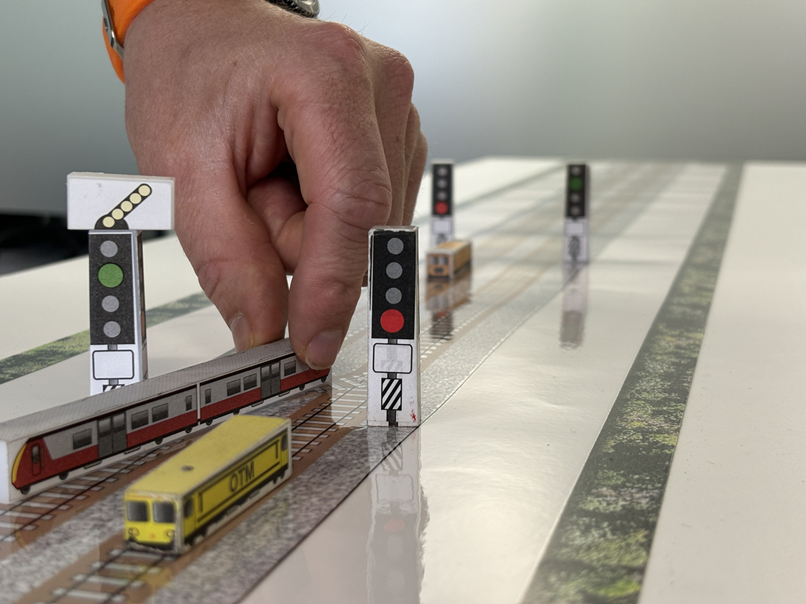
Route maps and scenario exercises can help users think through what might happen and what decisions may be required.
This is where route risk assessment connects strongly with simulation and practical learning.
People can explore situations safely before they face them in real life.
Using incident history
Past incidents can provide valuable learning.
A route risk assessment should consider whether certain locations have a history of operational incidents, near misses or recurring concerns.
This does not mean blaming individuals.
It means asking what the location, process, environment or task can teach the organisation.
For example:
- Are incidents occurring at similar times of year?
- Are they linked to low adhesion?
- Are they associated with workload or distraction?
- Are local instructions clear?
- Is the risk being briefed effectively?
- Do staff understand the location properly?
- Incident history helps make the assessment more evidence-based.
- It also helps ensure learning is connected to real experience.
Involving operational staff
The best route risk assessments are not completed in isolation.
Operational staff often hold valuable local knowledge.
Drivers, guards, controllers, managers, trainers and assessors may all understand different aspects of a route. They may know which locations require extra attention, where instructions are unclear, where trainees commonly struggle or where conditions change at certain times.
Involving people with practical experience improves the quality of the assessment.
It also helps build ownership.
Staff are more likely to trust a route risk process if it reflects what they know from experience.
Keeping route risk information current
Routes change.
Infrastructure changes. Timetables change. Rolling stock changes. Signalling arrangements change. Stations change. Operating instructions change. Incident trends change.
Route risk assessments and maps should therefore be reviewed.
If they are created once and forgotten, their value reduces over time.
A review process helps ensure that risk information remains current and useful.
Reviews may be triggered by:
- infrastructure changes
- new rolling stock
- incidents
- timetable changes
- staff feedback
- audit findings
- seasonal risks
- operational changes
Keeping information current supports better training and competence management.
Making information usable
The best route risk information is practical.
If a document is too long, too technical or difficult to navigate, people may not use it properly.
Information should be clear, accessible and focused on what users need to know.
Maps, diagrams, scenarios and summaries can help.
The aim is not to overload people with information. The aim is to help them understand the risk and apply that understanding in their work.
This is especially important during training.
A good trainer can use route maps to prompt discussion, test understanding and explore decision-making.
Supporting managers and assessors
Route risk assessment is useful for managers and assessors too.
Managers can use the information to plan briefings, identify development needs and focus attention on higher-risk areas.
Assessors can use route maps and risk information to structure competence discussions and practical reviews.
This supports consistency.
Instead of assessments depending purely on individual preference, they can be linked to known route risks and agreed expectations.
That helps strengthen assurance.
Final thoughts
Route risk assessment and mapping turn operational hazards into practical learning.
They help rail operators identify route-specific risks, understand where attention is needed and connect that information to training, competence assessment and safety management.
The value is not simply in producing a map or document.
The value is in how that information is used.
When route risk assessment is kept current, informed by operational experience and linked to training, it helps people understand the routes they work on more deeply.
For rail organisations, that means stronger route knowledge, more focused training and better support for safe operational decision-making.